Journey from Many to One Essentials of Advaita Vedanta by Swami Bhaskarananda
Author:Swami Bhaskarananda [Bhaskarananda, Swami]
Language: eng
Format: mobi, epub
Publisher: Viveka Press
Published: 2009-01-01T05:00:00+00:00
The individual ego is the product of ignorance (mûla-avidyâ)
This world is the product of mûla-avidyâ. The individual ego, which is part of this world, is also the product of mûla-avidyâ. Consciousness associated with this ego is called the tman or the Jîvâtman. Between the Jîvâtman and Brahman (Paramâtman) there is a thin veil of ignorance. It is like a cloud that does not allow an individual to see the sun. In this analogy Brahman is the sun and the patch of cloud is the ignorance of the individual. When this individual’s ignorance is dispelled by the knowledge of Brahman, he or she will have the experience of Brahman-ness.
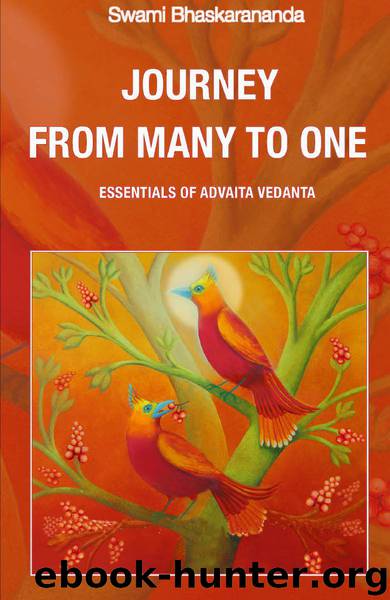
A scripture of Hinduism called the Mundaka Upanishad uses a beautiful analogy to explain how the Jîvâtman becomes one with the Paramâtman. It says that the Jîvâtman and the Paramâtman are like two identical birds of beautiful plumage, always united and known by the same name and clinging closely to the same tree (same body). One of them (the Jîvâtman) eats the tree’s sweet fruits (objects of sense pleasure). At first the objects of sense pleasure seem to be sweet and enjoyable, but eventually they taste terribly bitter. The other bird (the Paramâtman) looks on without eating (like a witness, totally disinterested in worldly pleasures).
Seated on the same tree, the Jîvâtman bird moans (due to its worldly troubles), bewildered by its impotence (helplessness). But when it thinks of the Paramâtman bird and meditates on how serene it is and how glorious, the Jîvâtman bird gradually becomes free from grief, as it finally realizes that it has all along been no other than the Paramâtman bird. (The suffering of the Jîvâtman is the result of its feeling of impotence. This impotence is destroyed by its knowledge of unity with the Paramâtman. The grief of the Jîvâtman is the result of its identification with its body-mind-complex.)
Footnotes for CHAPTER 10
1. In Hindu philosophy this analogy is called kantakoddhârana-nyâya.
2. As an alternative to this idea, Advaita Vedânta holds that Saguna Brahman, by His mâyâ, created the first being named Hiranyagarbha. Even though a created being, Hiranyagarbha has almost God-like powers. He is Cosmic Intelligence. By Saguna Brahman’s will, Hiranyagarbha created this world.
3. Consciousness or Brahman is the substratum of mûlâvidyâ. That is why consciousness manifests in mûlâvidyâ. Mûlâvidyâ is an upâdhi of Consciousness or Brahman. (For upâdhi see Chapter 13.)
Download
Journey from Many to One Essentials of Advaita Vedanta by Swami Bhaskarananda.epub
This site does not store any files on its server. We only index and link to content provided by other sites. Please contact the content providers to delete copyright contents if any and email us, we'll remove relevant links or contents immediately.
| Anthropology | Archaeology |
| Philosophy | Politics & Government |
| Social Sciences | Sociology |
| Women's Studies |
The remains of the day by Kazuo Ishiguro(8999)
Tools of Titans by Timothy Ferriss(8394)
Giovanni's Room by James Baldwin(7346)
The Black Swan by Nassim Nicholas Taleb(7129)
Inner Engineering: A Yogi's Guide to Joy by Sadhguru(6794)
The Way of Zen by Alan W. Watts(6614)
The Power of Now: A Guide to Spiritual Enlightenment by Eckhart Tolle(5781)
Asking the Right Questions: A Guide to Critical Thinking by M. Neil Browne & Stuart M. Keeley(5775)
The Six Wives Of Henry VIII (WOMEN IN HISTORY) by Fraser Antonia(5515)
Astrophysics for People in a Hurry by Neil DeGrasse Tyson(5189)
Housekeeping by Marilynne Robinson(4447)
12 Rules for Life by Jordan B. Peterson(4304)
Ikigai by Héctor García & Francesc Miralles(4274)
Double Down (Diary of a Wimpy Kid Book 11) by Jeff Kinney(4272)
The Ethical Slut by Janet W. Hardy(4251)
Skin in the Game by Nassim Nicholas Taleb(4248)
The Art of Happiness by The Dalai Lama(4130)
Skin in the Game: Hidden Asymmetries in Daily Life by Nassim Nicholas Taleb(4006)
Walking by Henry David Thoreau(3962)
